
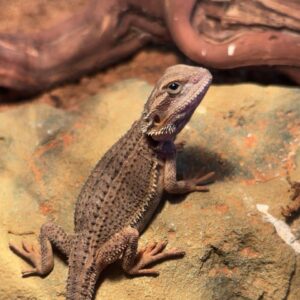
Bearded Dragon Orange Tigar Pair
£640.00
Only 1 left in stock



Bearded dragons are one of the most popular reptiles kept as pets around the globe, and for good reason – they are intelligent, docile and easy to take care of. When kept with other individuals, Beardies, particularly males can become territorial, so should always be kept alone. Our Bearded dragons are all bred in the UK, although naturally they hail from the Australian outback and as such thrive in very high temperatures and low humidity, which is relatively easy to achieve with the correct equipment What enclosure does a Bearded dragon need? Bearded dragons are decent-sized lizards that will appreciate lots of horizontal space with enough height to provide some elevated basking points. Wooden vivariums generally work the best due to their capacity to hold lots of heat, although glass or PVC enclosures can also work. At Swell Reptiles, we recommend a minimum adult enclosure size of 120 x 60 x 60cm (4 x 2 x 2ft) What heating equipment do I need for my Bearded dragon? Being desert reptiles, Beardies thrive in high temperatures, preferring a basking spot of around 40-42°C (104-107°F) and a cool end somewhere in the mid-20s. This is usually achieved using heat bulbs, although can also be done using a ceramic heat emitter. Any heating equipment should always be used in conjunction with a compatible thermostat, so dimming thermostats for basking lamps or pulse thermostat for ceramic heaters. Bearded dragons will not usually require any additional overnight heating, providing your home does not get colder than around 15°C (59°F). If overnight heating is required, this is best done using a non-light emitting heat source such as a ceramic heat emitter, but it is still better to have this set to a low, ambient temperature to mimic the natural drop in temperature when the sun sets. It is important that an accurate thermometer or two is used to monitor the temperature within your Bearded dragon enclosure and identify any faults with heating equipment as early as possible. Which UV should I get for my Bearded dragon? Bearded dragons are considered to be full sun baskers and as such require a high level of UVB to thrive and avoid serious health issues. This is best achieved using a T5 lighting system, with the percentage depending on the distance between the Beardy's highest basking point and the light itself. If your light will be between 25-30cm (10-12”) from the highest basking point, then a 6% T5 Kit will suffice, if the light will be between 30-45cm (12-18”) away, an Arcadia ProT5 – 12% Desert Kit would be required, any higher than this and an Arcadia ProT5 – 14% Dragon Kit would be required, providing this is no higher than 60cm (24”) from the highest basking point. How do I decorate a Bearded dragon’s vivarium? Bearded dragons are quite large-bodied lizards, so it is important when decorating their enclosure to ensure that any branches or platforms can hold their weight. In the wild, Beardies are semi-arboreal and can often be seen perching on low tree branches, therefore they will appreciate some robust branches and platforms to climb and perch on such as the Cork Branch and the Basking Platform. What do Bearded dragons eat? Bearded dragons are omnivores, so the main portion of their diet should be made up of leafy greens and vegetation, but they do also require regular livefood, with young Beardies needing more livefood than adults. Your Bearded dragon’s diet should be supplemented appropriately to ensure they are getting all of the nutrition they need. For this, we recommend the use of a high-quality multivitamin on every feed, such as Arcadia EarthPro-A, a calcium plus magnesium supplement on every fourth feed, such as Arcadia CalciumPro Mg and finally, a vitamin D3 supplement on every eighth feed such as Arcadia EarthPro RevitaliseD3.
Related products
Reptiles Amphibians And Invertebrates
Reptiles Amphibians And Invertebrates

Reptiles Amphibians And Invertebrates
Reptiles Amphibians And Invertebrates
Reptiles Amphibians And Invertebrates